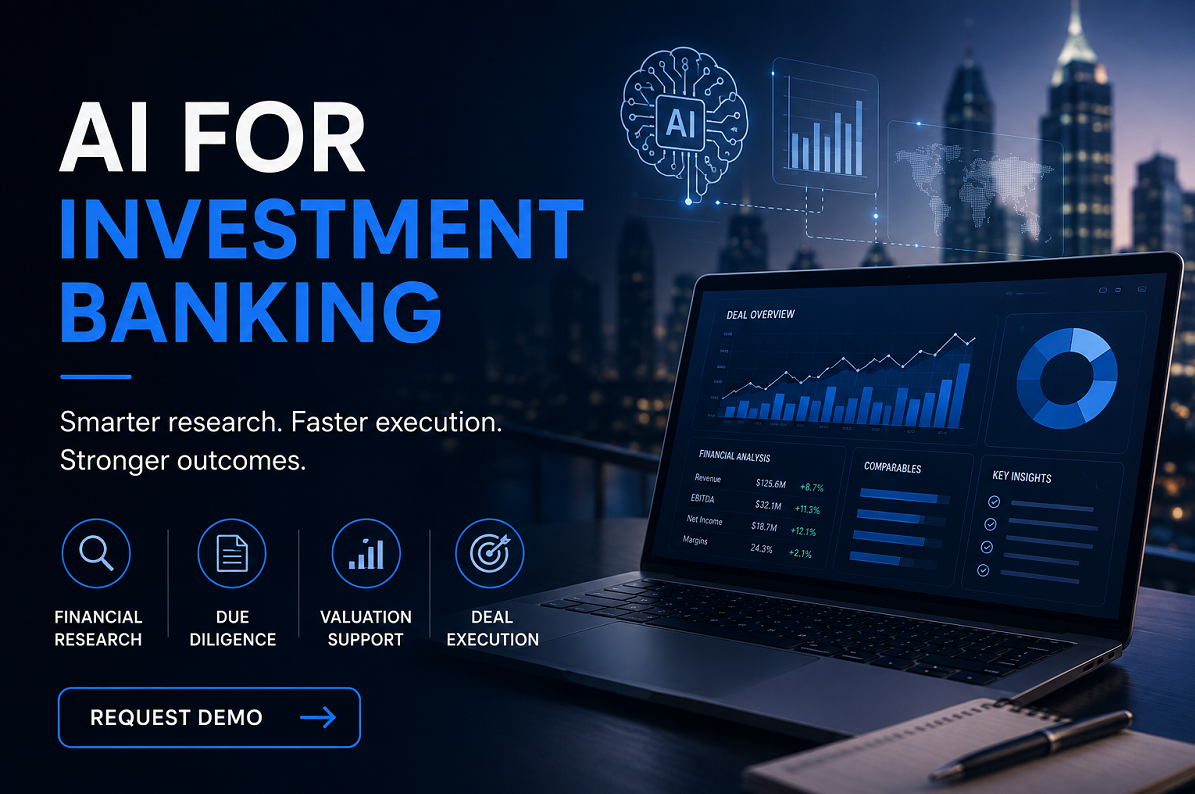
Investment banking has always been a business built around speed, information, and judgment. Analysts and deal teams work with enormous volumes of financial data, company documents, market research, valuation inputs, presentations, and transaction materials — often under intense time pressure. Artificial intelligence is beginning to reshape this environment by reducing repetitive work and helping professionals move from raw information to decision-ready insights faster.
One example of this shift can be seen in emerging financial AI platforms designed specifically for bankers, advisors, investors, and dealmakers. Platforms such as Brexy are positioning AI not simply as a chatbot, but as infrastructure for modern capital-markets workflows.
Request Demo: https://www.brexy.ai/solutions/investment-banking
Investment Banking Has an Information Problem
The modern investment banker does not suffer from a lack of information.
The challenge is having too much of it.
A single transaction can involve financial statements, annual reports, investor presentations, industry reports, comparable-company data, transaction databases, legal documents, management materials, spreadsheets, internal notes, and hundreds of pages of supporting documentation.
The traditional solution has been human effort.
Analysts manually search documents, transfer numbers into spreadsheets, summarize findings, prepare presentations, compare companies, and repeatedly update materials as new information becomes available.
This process works, but it is expensive in terms of time.
That makes investment banking particularly well suited for a new generation of AI-powered financial workflows.
From General AI to Financial AI
General-purpose artificial intelligence can summarize documents or answer questions, but investment banking requires significantly more context.
A banker is rarely asking a generic question such as:
“What does this company do?”
The real questions are more specific:
- How does this company compare with relevant public peers?
- Which operating metrics are driving valuation?
- What are the most important risks in the available materials?
- Which transactions are genuinely comparable?
- What information is missing from the investment thesis?
- How should the findings be structured for a pitch book or internal memo?
This is where financial AI becomes more valuable than generic automation.
A finance-focused system can be designed around the terminology, documents, analytical frameworks, and outputs used by investment professionals.
The difference is important.
The objective is not simply to generate text faster. It is to improve the entire process through which financial information becomes analysis.
AI Financial Research Can Compress Hours Into Minutes
Research is one of the most obvious opportunities.
Investment bankers regularly need to understand unfamiliar companies, sectors, competitors, transactions, and market developments in a very short period of time.
Historically, this process may involve opening dozens of sources, searching through documents, extracting relevant passages, comparing numbers, and manually organizing the findings.
With AI financial research, the workflow can become much more efficient.
AI can help professionals:
- process large volumes of financial information;
- summarize lengthy documents;
- extract relevant company and industry data;
- identify recurring themes;
- organize research into structured formats;
- compare information across multiple sources;
- accelerate preparation for meetings and pitches.
The value is not merely saving an hour of research.
The greater advantage is allowing the analyst to spend more time interpreting the information.
The Rise of AI-Powered Due Diligence
Due diligence is another workflow where artificial intelligence can have substantial impact.
During a transaction, deal teams may need to review large document sets while simultaneously identifying risks, inconsistencies, financial trends, contractual details, and other relevant information.
Traditional document review can become a bottleneck.
AI-assisted due diligence can help reduce that bottleneck by rapidly searching, classifying, and summarizing information across extensive documentation.
For example, AI can help surface:
- unusual financial movements;
- important contractual language;
- discrepancies between documents;
- operational risks;
- key customer or supplier information;
- historical performance trends;
- information requiring additional investigation.
Human verification remains essential.
However, AI can significantly reduce the amount of time professionals spend simply locating the information that deserves their attention.
Better Use of Analyst Time
One of the biggest discussions surrounding AI in finance focuses on whether automation will replace junior bankers.
A more practical question is:
What work should highly trained analysts actually be spending their time on?
Copying numbers between documents is necessary, but it is not where an analyst creates the greatest value.
Neither is manually searching hundreds of pages for a specific piece of information.
Investment bankers create more value when they are:
- evaluating assumptions;
- challenging valuation logic;
- identifying transaction risks;
- understanding strategic alternatives;
- preparing recommendations;
- communicating with clients;
- analyzing how new information changes the deal.
AI can remove some of the lower-value friction surrounding those activities.
Instead of replacing the analyst, it can change the ratio between administrative work and analytical work.
Faster Pitch Books Without Sacrificing Judgment
Pitch book production remains one of the most recognizable investment-banking workflows.
A typical presentation may contain company profiles, market analysis, industry trends, precedent transactions, comparable companies, valuation outputs, strategic alternatives, and proposed transaction structures.
Producing these materials can consume substantial analyst and associate time.
AI-enabled workflows can accelerate the first stages of this process by helping teams gather information, organize research, summarize findings, and prepare structured drafts.
The banker then applies the most important layer:
judgment.
Which information matters?
Which narrative will resonate with the client?
Which comparable companies are truly relevant?
Which assumptions are defensible?
Which strategic recommendation makes the most sense?
Artificial intelligence can accelerate production, but the banker still determines the story.
AI and the Future of Financial Modeling
Financial modeling is unlikely to disappear.
Instead, the surrounding workflow may become considerably more automated.
Before an analyst can evaluate a DCF, LBO, merger model, or comparable-company analysis, significant preparation is usually required.
Historical financial information needs to be collected.
Metrics need to be normalized.
Assumptions need to be researched.
Sources need to be reviewed.
AI can assist with these preparatory stages and make financial information easier to access and organize.
This allows professionals to dedicate more attention to the areas where expertise matters most:
assumptions, scenarios, sensitivities, transaction structures, and interpretation.
In other words, the future of AI in financial modeling may be less about letting machines make investment decisions and more about eliminating unnecessary friction before the decision.
The Competitive Advantage Is Moving Up the Stack
For years, technology in investment banking primarily focused on databases, spreadsheets, communication systems, and data terminals.
AI introduces another layer.
It can sit between information and the professional who needs to interpret it.
That changes the competitive equation.
If two advisory teams have access to similar public information, comparable valuation methodologies, and similar transaction databases, the advantage may increasingly go to the team that can:
- process information faster;
- investigate more scenarios;
- respond to clients sooner;
- identify relevant insights earlier;
- maintain a deeper understanding of the transaction.
The competitive advantage is no longer simply access to information.
It is the ability to convert information into useful intelligence faster.
Why AI Infrastructure Matters More Than Individual Tools
Many organizations currently experiment with separate AI tools for research, writing, document analysis, or productivity.
However, investment banking is not a collection of independent tasks.
The workflows are connected.
Research affects the investment thesis.
The investment thesis affects valuation.
Valuation affects positioning.
New due-diligence findings affect the model.
The model affects the presentation.
The presentation affects the transaction strategy.
This is why the concept of AI infrastructure for capital markets may ultimately matter more than individual AI features.
Brexy reflects this broader direction by positioning its platform specifically around financial professionals such as investors, bankers, advisors, and dealmakers rather than treating financial work as another generic enterprise use case.
Human Judgment Remains the Final Layer
Despite rapid advances in AI, investment banking remains fundamentally human.
A successful transaction requires more than data processing.
It requires negotiation.
It requires understanding management teams.
It requires reading investor sentiment.
It requires recognizing when a financial assumption looks technically correct but commercially unrealistic.
It requires knowing when a client should proceed with a transaction — and sometimes when they should not.
AI can improve the information environment around these decisions.
It cannot eliminate responsibility for making them.
That is why the strongest investment-banking model is likely to be human judgment amplified by specialized AI, rather than human judgment replaced by it.
The AI-Native Investment Bank
The next generation of investment banking may therefore look very different from the traditional analyst workflow.
Instead of manually searching through every document, professionals may begin with AI-assisted research.
Instead of rebuilding information from scratch for every presentation, teams may work from structured intelligence.
Instead of spending hours searching for relevant details during due diligence, AI may surface the highest-priority information for review.
Instead of treating every transaction as a disconnected set of files, systems may increasingly connect research, analysis, valuation, documentation, and execution.
The investment bank does not disappear.
It becomes more intelligent.
Conclusion
Artificial intelligence is moving from an experimental productivity tool toward a genuine operating layer for financial professionals.
The biggest opportunity is not simply generating faster text or automating isolated tasks.
It is reducing the distance between information and decision-making.
For investment bankers, this could mean faster research, more efficient due diligence, improved document analysis, streamlined pitch preparation, stronger financial workflows, and more time for strategic judgment.
The firms that benefit most will likely be those that view AI not as a replacement for financial expertise, but as infrastructure that allows that expertise to operate more efficiently.
For investment banking teams exploring this new operating model, Brexy provides a purpose-built financial AI platform designed for capital-markets professionals.


